Proper selection of waterproofing systems is critical to ensuring the long-term durability and structural integrity of buildings. In this context, the question of what a membrane is frequently arises in both residential construction and large-scale industrial applications. Membranes are waterproofing layers applied to surfaces such as roofs, terraces, balconies, bathrooms, and basements to prevent water penetration into the structure. In this article, we compare liquid PU membranes with roll membranes and explain their usage areas and which system is more suitable for different types of projects.
What Is a Membrane?
A membrane is a waterproofing layer applied to building surfaces to prevent water infiltration. For this reason, it is considered a fundamental component of waterproofing systems. Today, membranes are generally divided into two main categories in terms of formulation and application method: liquid membranes and sheet (roll) membranes. Both systems provide effective waterproofing when applied correctly; however, usage conditions and surface geometry determine the ideal choice.
Importance of Membranes in Waterproofing
Water is one of the most damaging elements for building materials. Especially in roofs, terraces, and wet areas, insufficient waterproofing can lead to moisture, mold, plaster deterioration, and reinforced concrete damage. Therefore, membrane application is a crucial step that should not be overlooked in both new constructions and renovation projects. In addition, selecting the right membrane significantly reduces long-term maintenance and repair costs.
What Is a Liquid PU Membrane?
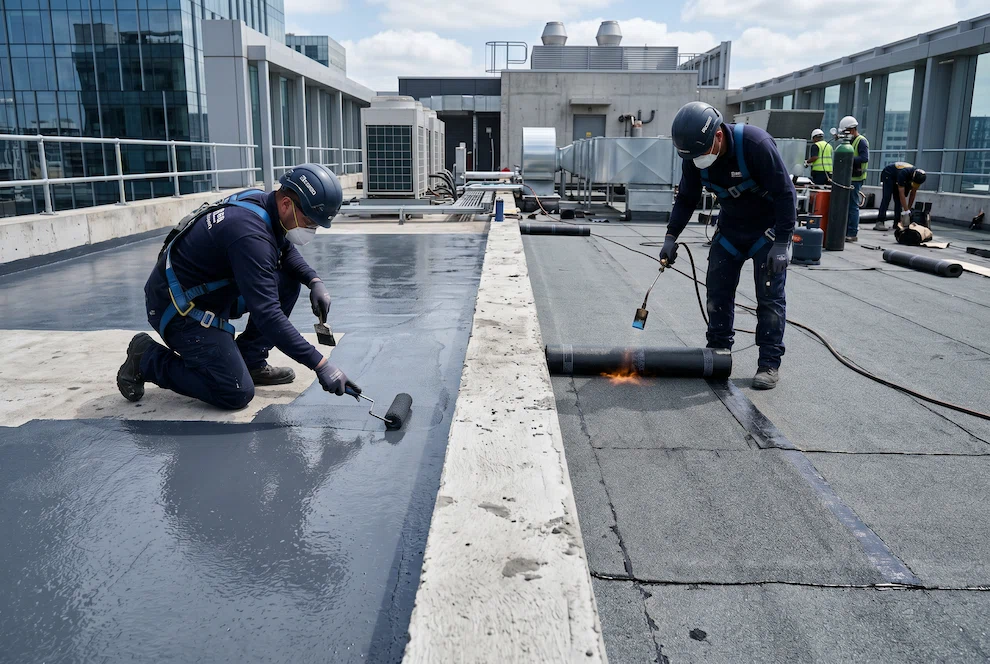
A liquid PU membrane is a flexible waterproofing layer formed by applying polyurethane-based compounds in liquid form onto surfaces. After application, it cures to form a continuous, seamless, and elastic coating. Thanks to this property, it provides complete protection even in critical areas such as corners, channels, and irregular geometries. Compared to roll membranes, it adapts much more easily to complex surfaces.
Key Features of Liquid PU Membrane
- Forms a seamless and continuous waterproof layer
- Adapts perfectly to complex surface geometries
- UV-resistant formulations are available
- High elasticity with crack-bridging capability
- Available in single- or two-component systems (1K / 2K)
- Fast curing time, allowing easier project scheduling
Where Is Liquid PU Membrane Used?
Liquid PU membranes are commonly used in roof and terrace waterproofing, balconies and ground floors, bathrooms and wet areas, water tanks and swimming pools, and foundation or basement applications. Additionally, their ability to be applied directly over existing surfaces makes them highly advantageous in renovation projects.
What Is a Roll Membrane?
A roll membrane is a waterproofing material manufactured in factories at a specific thickness and supplied in ready-to-use sheets. Typically made from bitumen, TPO, or PVC, these membranes are installed by bonding, welding, or mechanical fastening. Roll membranes are particularly effective in large and flat areas, offering fast application in standard geometric surfaces.
Key Features of Roll Membrane
- Factory-controlled production ensures consistent thickness
- Fast installation on large flat surfaces
- High resistance to mechanical impact
- Available in different materials such as bitumen, TPO, and PVC
- Joints are sealed with special tapes or welding methods
Liquid PU Membrane vs Roll Membrane: Key Differences
| Feature | Liquid PU Membrane | Roll Membrane |
| Application Method | Applied as liquid using brush/roller | Installed as sheets via bonding or welding |
| Seamless Surface | Fully seamless | Contains joint seams |
| Adaptability to Complex Surfaces | Very high | Limited |
| Thickness Control | Depends on applicator | Factory-controlled and uniform |
| Speed on Large Flat Areas | Moderate | High |
| Renovation Suitability | Very easy | More complex |
When Should You Choose Liquid PU Membrane?
If the project involves angled, curved, or transition areas such as roof drains, chimney surroundings, or pipe penetrations, liquid PU membrane offers a significant advantage. It is also ideal when application over existing concrete or screed without demolition is required. Furthermore, it is a strong choice for renovation projects where speed and practicality are priorities.
When Should You Choose Roll Membrane?
Roll membranes are more suitable for large, flat roof or terrace surfaces where the geometry is simple and uniform. They are also preferred when factory-guaranteed thickness is important or when high mechanical durability is required.
Polin Kimya Waterproofing Products and Systems
For your waterproofing needs, you can explore Polin Kimya’s product and system categories:
For application videos and project examples, follow Polin Kimya on YouTube | Instagram
Contact our technical team for support or detailed information about your project.
Frequently Asked Questions
Can liquid PU membrane and roll membrane be used together?
Yes, in some projects both systems are used together. For example, roll membranes may be applied on large flat surfaces, while liquid PU membranes are used for detailing areas such as drains, corners, and joints. This combination provides both speed and seamless protection.
Why is surface preparation important before membrane application?
The application surface must be clean, dry, and structurally sound. Otherwise, the membrane may not adhere properly, leading to blistering or leakage issues over time. Therefore, using an appropriate primer before application is highly recommended.
What is the lifespan of a liquid PU membrane?
With correct application and proper material selection, liquid PU membranes can provide long-lasting protection for many years. Their lifespan depends on usage conditions, UV exposure, and maintenance frequency. In exterior applications, selecting UV-resistant formulations significantly extends durability.