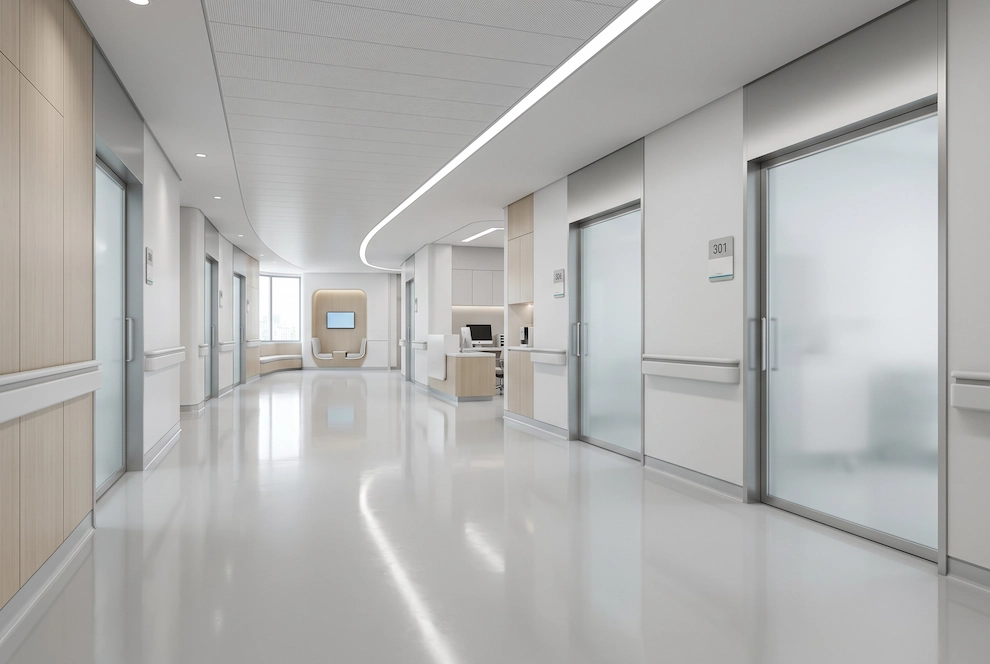
Hospital flooring plays a critical role in ensuring patient safety, infection control, and maintaining a sterile environment in healthcare facilities. Standard industrial flooring systems are not always sufficient to meet these requirements. Therefore, selecting the right system for healthcare environments requires evaluating multiple technical factors such as hygiene, chemical resistance, slip safety, and long-term durability.
Key Requirements for Flooring in Healthcare Facilities
The performance expectations of flooring in healthcare environments go far beyond those of standard commercial or industrial spaces. Moreover, each department has its own specific requirements, meaning a single system cannot be applied across the entire hospital.
The essential properties required in healthcare flooring systems include:
- Antibacterial surface structure that prevents the growth of bacteria, fungi, and viruses
- High resistance to chemical disinfectants and clinical cleaning agents
- Seamless, joint-free surface that eliminates microbial accumulation points
- High slip resistance in both wet and dry conditions to ensure patient and staff safety
- Mechanical durability suitable for heavy wheeled traffic
- Quiet and comfortable walking surface, especially for patient rooms and corridors
- Easy and fast disinfection capability
Hospital Flooring Systems
Several flooring systems are used in healthcare facilities, each designed for specific departments and requirements.
Epoxy Flooring Systems
Epoxy flooring is one of the most commonly used systems in hospital corridors, operating rooms, laboratories, and technical areas. Its seamless and smooth surface eliminates bacterial growth points. Additionally, it offers high resistance to chemical disinfectants and clinical cleaning agents. Epoxy self-leveling systems, in particular, provide excellent surface smoothness, making them ideal for operating rooms and cleanroom environments.
Electrostatic Discharge (ESD) Epoxy Systems
In areas where sensitive medical equipment is used, static electricity buildup can pose serious risks. ESD epoxy flooring prevents this accumulation, protecting both equipment and personnel. It is especially preferred in operating rooms and intensive care units.
Polyurethane Flooring Systems
Polyurethane flooring systems are commonly used in hospital kitchens and sterilization units, where frequent temperature fluctuations occur. Thanks to their flexible structure, they offer better resistance to thermal shock and vibration compared to epoxy systems.
Polyurethane Cement Systems
Polyurethane cement systems are ideal for high-temperature and high-moisture environments such as hospital kitchens and dining areas. Their high steam resistance, slip-resistant surface, and thermal shock durability make them a preferred solution in these spaces.
Choosing the Right System by Department
Each department in a healthcare facility has different flooring requirements. Therefore, selecting systems based on usage areas ensures both performance efficiency and cost optimization.
| Hospital Area | Recommended System | Key Requirement |
| Operating rooms | ESD epoxy self-leveling | Static control, seamless hygiene |
| Corridors | Epoxy coating | High traffic resistance, easy cleaning |
| Kitchens & service areas | PU cement system | Thermal shock resistance, anti-slip surface |
| Laboratories | Chemical-resistant epoxy | Acid and alkali resistance |
| Patient rooms | Homogeneous vinyl or epoxy | Comfort, hygiene, low noise |
| Sterilization units | Polyurethane flooring | Moisture and heat cycle resistance |
Polin Kimya Healthcare Flooring Solutions
Polin Kimya offers high-performance epoxy and polyurethane flooring systems designed for healthcare facilities. You can explore the following pages to find the most suitable solution for your project:
For reference projects and technical content, follow Polin Kimya on LinkedIn | Instagram | YouTube
Contact the Polin Kimya technical team for flooring systems that meet hospital hygiene standards.
Frequently Asked Questions
Which flooring system should be used in operating rooms?
ESD epoxy self-leveling systems are preferred in operating rooms. They provide a seamless, hygienic surface while preventing static electricity buildup that could damage sensitive medical equipment. Operating rooms are among the most critical areas in hospital flooring selection.
Do hospital disinfectants damage flooring systems?
Epoxy and polyurethane flooring systems designed for healthcare environments are formulated to resist chemical disinfectants and clinical cleaning agents. However, following the manufacturer’s recommended cleaning protocols is essential to extend system lifespan.
How often should hospital flooring be replaced?
High-quality epoxy or polyurethane flooring systems can last an average of 8 to 12 years in hospital environments when properly maintained. In high-traffic areas such as corridors and sterilization units, periodic inspections and localized repairs help extend system lifespan.