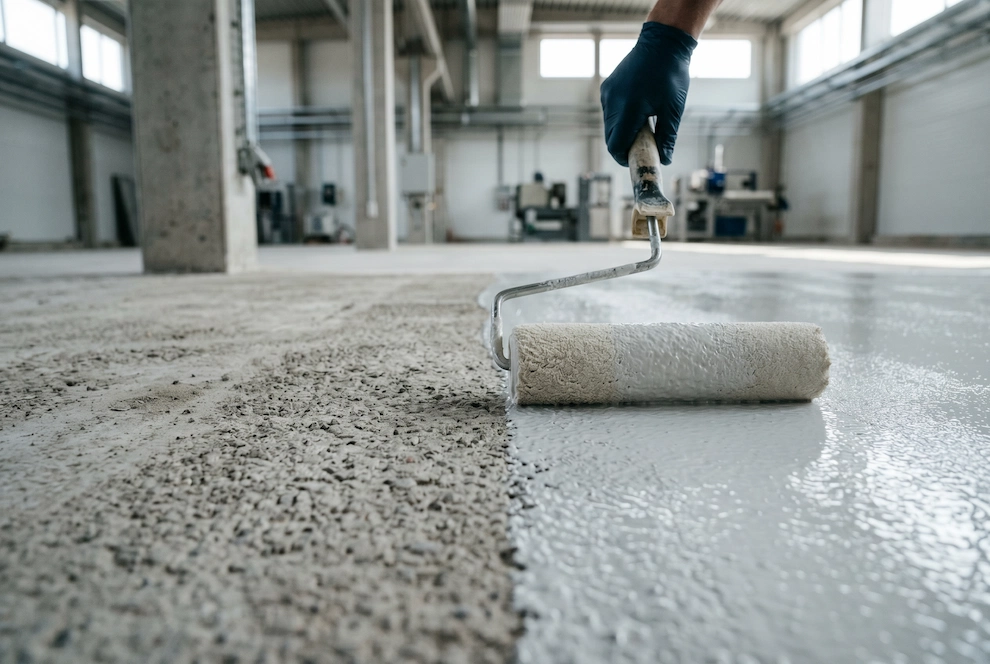
Concrete primer is one of the most fundamental and critical components of flooring systems. Applied to the concrete surface before epoxy paint or polyurethane coating, it directly determines the integrity and long-term durability of the entire system. However, the priming stage is often overlooked, which leads to serious coating failures over time.
What Is Concrete Primer?
Concrete primer is a specially formulated product used to close the pores of concrete surfaces, regulate surface absorption, and enhance the adhesion of subsequent coating layers. It can be based on epoxy, polyurethane, or acrylic systems, each developed for different application conditions.
If the priming stage is skipped, the floor coating cannot properly bond to the concrete surface. This leads to issues such as peeling, blistering, and delamination in a short period of time.
The Role of Concrete Primer in Flooring Systems
Improving Adhesion
When coating materials are applied directly to concrete, sufficient adhesion is not always achieved due to surface porosity, dust, and moisture. Concrete primer eliminates this issue by creating a strong bond between the coating and the substrate.
Regulating Surface Absorption
Concrete is a naturally porous material. This porosity causes uneven absorption of coating materials, resulting in inconsistent application. Primer helps balance surface absorption, ensuring a uniform and smooth coating layer.
Creating a Moisture Barrier
Rising moisture from the substrate poses a serious threat to flooring systems, especially in basements and ground floors. In such cases, special moisture-barrier primers are required to prevent moisture from affecting the coating system.
Filling Surface Imperfections
Concrete surfaces may contain small cracks, pores, or irregularities. Primer helps partially fill these imperfections, providing a smoother surface for the coating system.
Types of Concrete Primers
| Primer Type | Application Area | Key Feature |
| Epoxy primer | Factories, warehouses, chemical plants | High adhesion, chemical resistance |
| Polyurethane primer | Cold storage, outdoor areas | Flexibility, UV resistance |
| Acrylic primer | Light traffic, indoor spaces | Fast drying, cost-effective |
| Moisture barrier primer | Basements, ground floors | Prevents moisture transmission |
Key Considerations in Concrete Primer Application
- The surface must be completely dry, clean, and free from oil or contaminants.
- The concrete surface should be roughened using grinding or shot blasting before application.
- The primer must be fully cured before applying the coating system.
- If multiple coats are required, manufacturer instructions must be strictly followed to ensure proper bonding between layers.
Polin Kimya Concrete Primer Products
Polin Kimya offers high-performance primer products compatible with epoxy and polyurethane flooring systems. You can explore the following pages to find the most suitable solution for your project:
For more information about Polin Kimya primer products and application techniques, follow us on LinkedIn | YouTube | Instagram
Contact Polin Kimya experts to ensure the right primer system for long-lasting flooring performance.
Frequently Asked Questions
Is primer required for every flooring application?
In almost all industrial flooring systems applied on concrete surfaces, primer usage is mandatory. Without primer, the coating cannot properly bond to the substrate, leading to early peeling. Some special products may not require primer, but this must be clearly stated in the manufacturer’s technical data sheet.
What is the difference between epoxy primer and polyurethane primer?
Epoxy primer is known for its strong adhesion and high chemical resistance, making it suitable for indoor and chemically exposed environments. Polyurethane primer offers higher flexibility and UV resistance, making it more suitable for outdoor applications. The correct choice depends on the coating system and environmental conditions.
How long should you wait after applying primer?
Drying time depends on primer type, temperature, and humidity. Epoxy primers are generally ready for coating within 4 to 24 hours. Polyurethane primers may have different curing times depending on product formulation and environmental conditions. In all cases, manufacturer technical data sheets must be followed.